
This is the second day of my form poetry unit. If you’d like to take a look at what I did on day one, you can check it out here. I’ve also just added a full unit overview here!
My favorite poetic form is the villanelle, probably dating back to a college professor who taught “Do Not Go Gentle” with such passion. On day two of my poetic form unit, we read “Mad Girl’s Love Song” by Sylvia Plath, consider the impact of form and musical devices on the poem, and then free write to prepare for writing our own villanelles.
Here are the details…
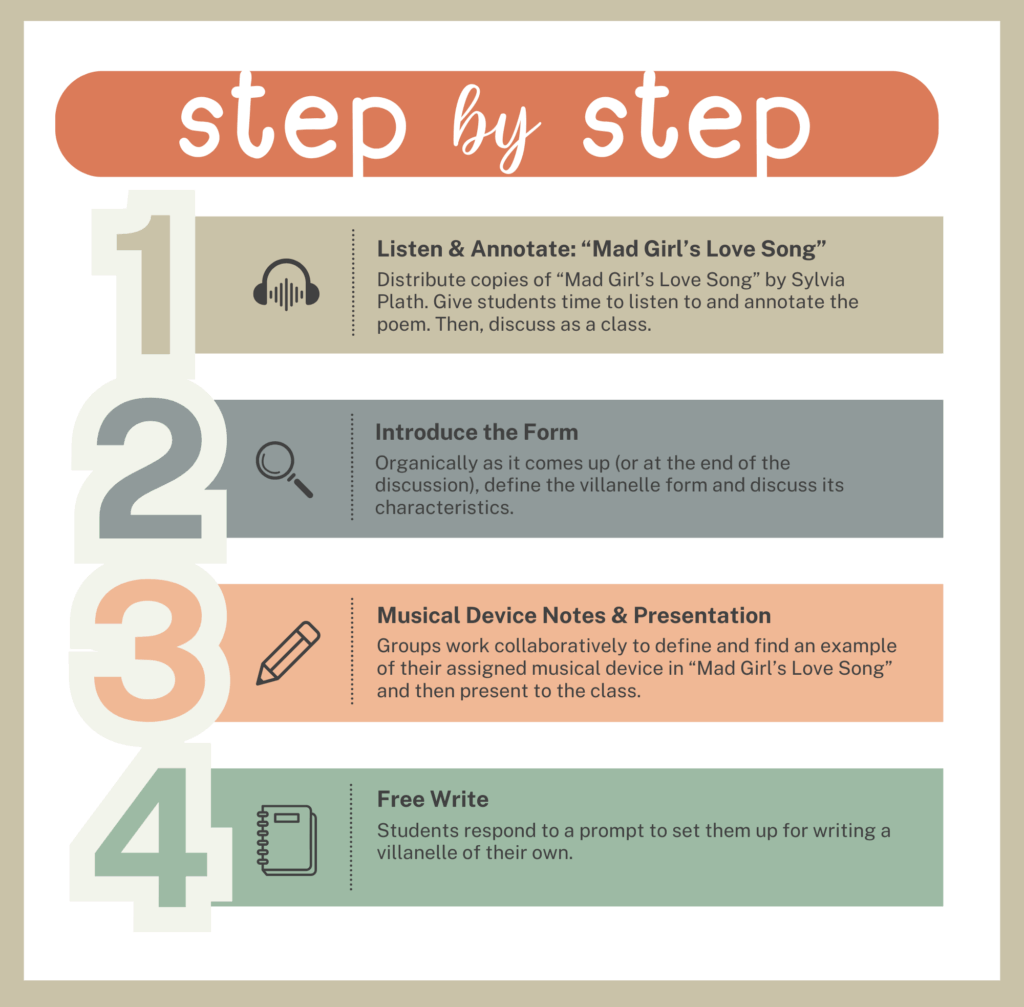
- Listen & Annotate: “Mad Girl’s Love Song” — I play the poem twice for students as they follow along on their papers. This gives us the jumping off point for our whole-class discussion. After the two rounds, I put the poem under the document camera and open the floor for observations. I mark up my copy of the text as students share, and by the end we have a good understanding of the text’s meaning at a literal and figurative level. These are the prompts I give students for the two listening rounds:
- Round 1: Consider the poem at a literal level. What do you understand about the speaker? To whom is she speaking? What happened to her? How does she feel about it? What are the two different ways she attempts to deal with it?
- Round 2: What is the relationship between the poem’s form and its meaning?
- Introduce the Form — Either in the midst of our whole-class discussion, or at the end, we define the form of the villanelle. At this point, I’ll usually pull up a few other examples to show how poets will sometimes modify the refrains (as in “One Art” by Elizabeth Bishop), sometimes strictly adhere to the repetition (as in “Do Not Go Gentle Into the That Good Night” by Dylan Thomas), and often write in iambic pentameter (like all three).
- Musical Device Notes & Presentations — At this point, I assign each group one musical device and pass out copies of a note sheet (free in my TPT store!). I ask them to reread the poem looking for a best example of that musical device and connect that to its meaning. One thing I emphasize all year long is the importance of connecting devices to meaning, as opposed to just being able to identify them. After groups have had time to prepare what they will say, each group takes a turn presenting their device under the document camera while the rest of the class takes notes. An important side note is that this is not the students’ first exposure to these sound devices.
- Free Write — We finish class with a free write that prepares students to write a villanelle of their own for homework. The free write prompt is based on English Professor Philip K. Jason’s suggestion that the “villanelle is often used, and properly used, to deal with one or another degree of obsession.” I have students make a list of their “obsessions” and then share a few that they are comfortable sharing. For homework, I ask them to write a villanelle about an obsession (iambic pentameter is optional).
At the end of this form poetry unit, students choose one poem they’ve written (a sestina, villanelle, or sonnet) to take through a revision process and submit. One requirement is that the poem must make use of musical devices, so all of this comes into play later on.


3 Responses