
I begin second semester with a mini-unit on fixed form poetry. While the study of poetry is infused in the curriculum throughout the year through thematic units, I like to slow down and hone poetry analysis skills twice in the year: once at the very beginning of the school year and then again at the start of the second semester.
I’ve been writing day-to-day lesson plan posts for my form poetry unit, but I’m realizing that the big picture is missing. So, in this post, I’m including the unit structure, essential question, AP skills addressed, and assessments. I hope it’s helpful if you’re interested in borrowing any of these ideas!
Unit Essential Question: What is the relationship between a poem’s form and its meaning?
AP English Literature & Composition Focus Skills:
- 3.C Explain the function of structure in a text.
- 5.B Explain the function of specific words and phrases in a text.
- 7.C Develop commentary that establishes and explains relationships among textual evidence, the line of reasoning, and the thesis.
- 7.D Select and use relevant and sufficient evidence to both develop and support a line of reasoning.
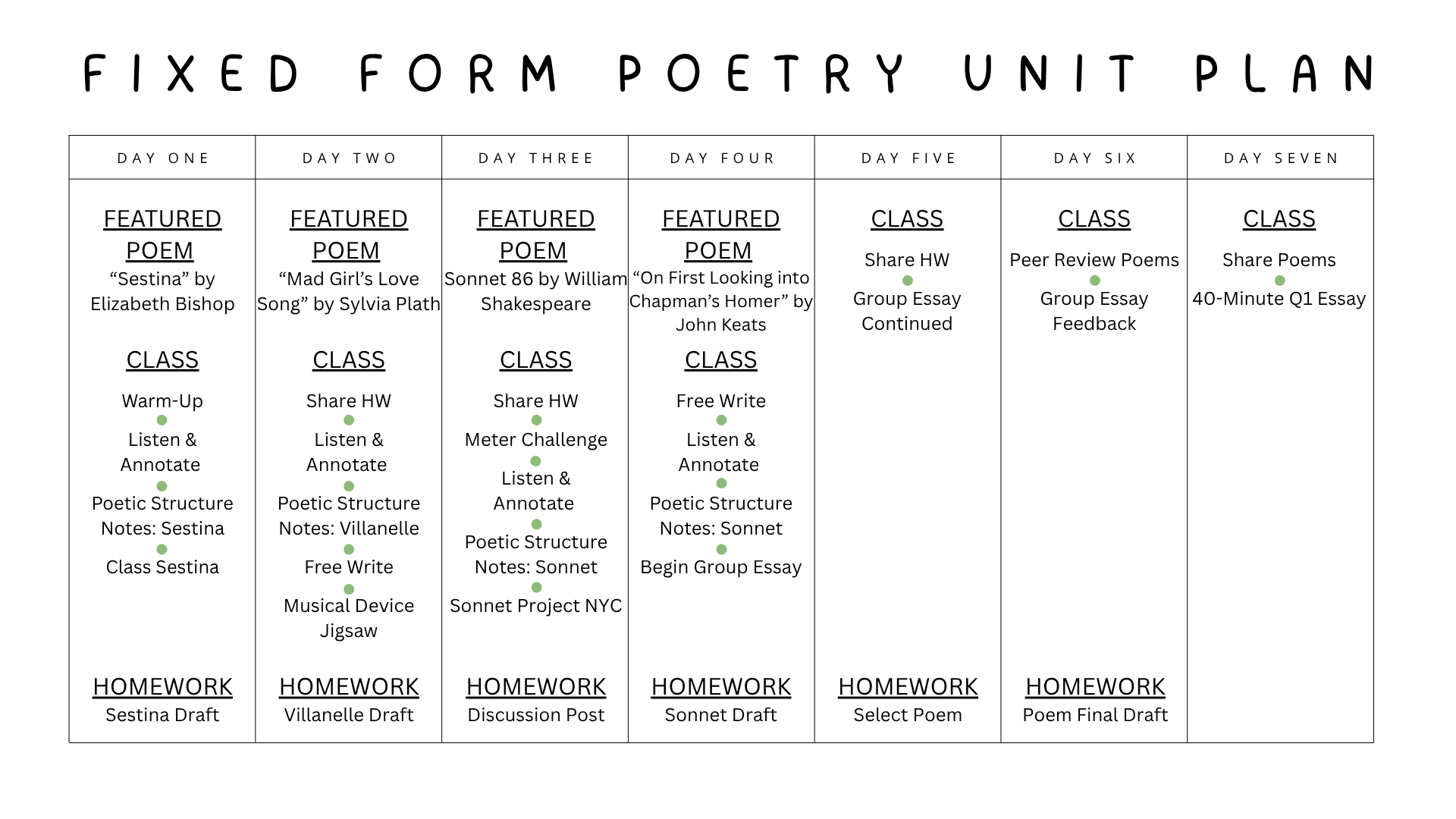
Unit Structure: In recent years, I teach this unit in seven 85-minute class periods, so it spans about 2.5 weeks. You could most certainly stretch it and cover a lot more (as I often have in the past), but this is the current iteration that allows me to fit everything on my second semester calendar. I have four blog posts that break down the first four days in great detail: Day One, Day Two, Day Three, and Day Four.
Assessments: There are three assessments in this unit, as follows…
- Original Poem: Students draft a sestina, villanelle, and sonnet, which they share in small groups on the days they are due. Then, I ask students to pick one to revise. The selected poems go through a peer review and revision process before students submit a final draft. I ask them to include at least three musical devices, since we’ve been discussing those in the unit. Along with the poem, students submit an explanation of how their selected form impacts their poem’s meaning as well as an explanation of how the musical devices enhance meaning. While I do grade the overall success of their poem, the bulk of the grade is associated with their ability to correctly utilize the form (they have to identify any purposeful variations) and to explain how the form interacts with meaning.
- Group Q1 Essay: Students work in groups of three to draft an essay together. I don’t count this as an assessment in the grade book, but I do tell them how the essay would score on the exam and I provide feedback. You can read more about the Q1 group essay here.
- 40-Minute Q1 Essay: I finish the unit with a 40-minute in-class essay. I will either cull released prompts for sonnets, or create my own prompts based on sonnets. Here are a few released sonnet prompts. Note you’ll have to update the language to match the current stable prompt wording.


One Response