This is the fourth day of my form poetry unit. You can view Day 1, Day 2, and Day 3 if interested. I’ve also just added a full unit overview here!
This is the second day we work with sonnets in the form poetry unit, and today students are introduced to the Italian sonnet form and also practice their Q1-style analytical writing.
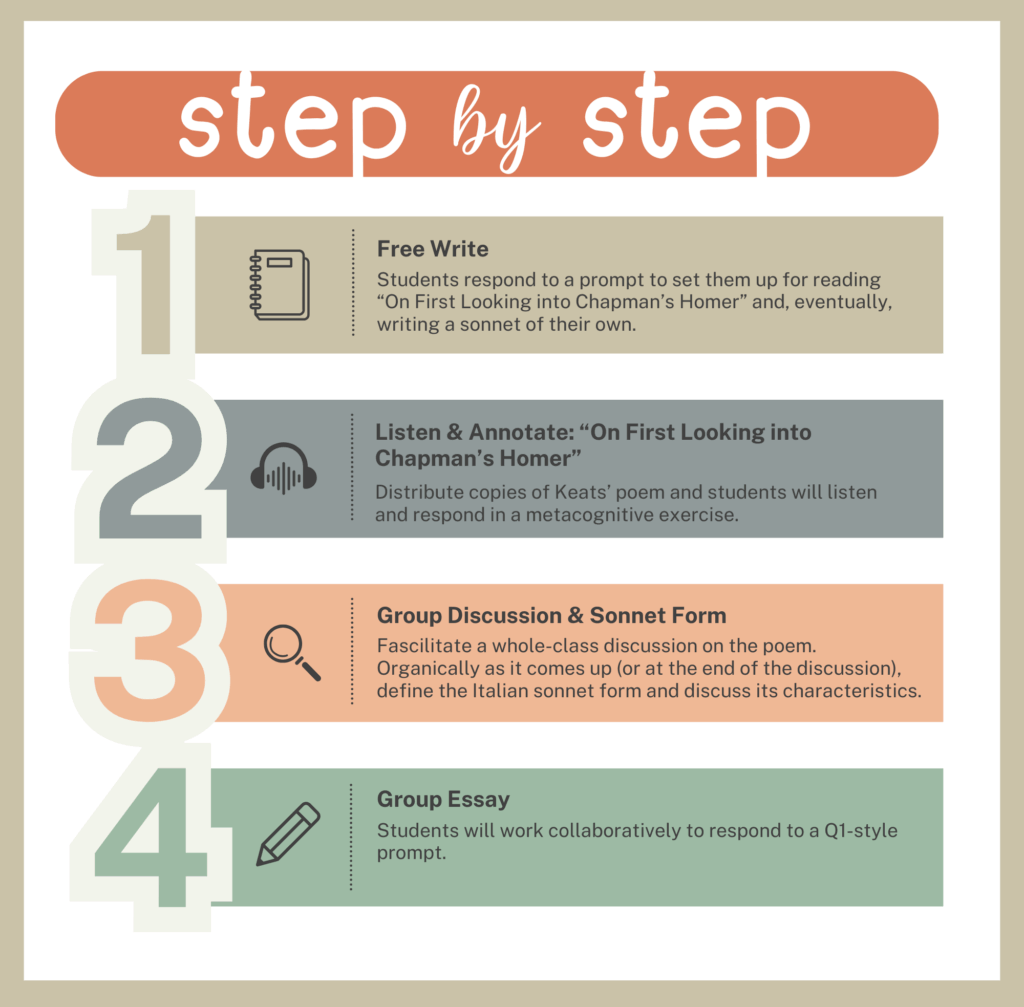
Here are the details:
- Free Write — To introduce Keats’ sonnet as well as to generate content for students’ original sonnets later on, begin with this free write: Free write about your first experience with something that you find beautiful and/or that ignited a lifelong passion. It might be a kind of art (painting, sculpture, literature, architecture, film, music, theater), a sport or hobby, an academic subject, etc.
- Listen & Annotate: “On First Looking into Chapman’s Homer” — Distribute copies of Keats’ sonnet. For this poem, I lead students through a short metacognitive exercise to help them develop the skills they need to break down complex texts. Here are the steps:
- I play audio of the poem, and ask students to highlight in one color anything that they understand well enough to be able to explain it to someone else, and in another color, anything that they do not understand.
- After the highlighting, students share understandings and confusion in small groups (or partners).
- I ask groups/partners to identify one place in the poem in which there is enduring confusion and apply a “fix-it” strategy (adapted from I Read It, but I Don’t Get It by Cris Tovani). See the photo below for the fix-it strategies that I share with them.
- Finally, I open it to a whole-class discussion. Groups/partners share a fix-it strategy that they applied and the extent to which it helped them make sense of the text.
- Group Discussion & Sonnet Form — After the metacognitive exercise, we usually listen to the poem again and then discuss it as a class, with the document camera ready for note taking. As part of this discussion, we define the form of the Italian sonnet and explore how the form of the sonnet creates/enhances meaning in this text. For homework, students will draft a sonnet of their own that deals with a revelatory moment. They can use the topic that they wrote about for the free write and I allow them to choose whether to write an English/Shakespearean or Italian/Petrarchan sonnet.
- Group Essay — At this point, it’s time to get into some practice Q1 writing. About once per semester, I like to have students write an essay collaboratively. It helps them learn from one another as they develop their on-demand writing skills. I arranged students in groups of three so that each person could be responsible for one body paragraph. For this lesson, I had students follow these steps:
- First, work with group members to write a thesis in response to this prompt: In John Keats’s poem “On First Looking into Chapman’s Homer,” published in 1816, the speaker writes about the first time he heard a translation of Homer, the classical Greek poet, by George Chapman, an Elizabethan poet. Read the poem carefully. Then, in a well-written essay, analyze how Keats uses literary elements and techniques to develop the speaker’s complex experience with the poetry reading.
- I checked each group’s thesis before they moved onto the next step to ensure they had mastered Row A on the rubric and established complexity. This lesson falls near the start of second semester for me, so students already have practice with thesis statements and understand what they need to entail.
- After groups got the go-ahead on their thesis statements, each person takes ownership of one section of the poem (lines 1-4, lines 5-8, lines 9-14). Their task is to highlight evidence in this section of the poem that they can use to support the group’s thesis and label at least one literary or musical device that they can connect to that evidence.
- Before moving onto the next step, group members confer with one another to ensure that the evidence they’ve each selected is most apt in support of the thesis.
- This portion of the task might extend over to the next class period, but ultimately each student writes a body paragraph associated with their section of the text. I teach students to write their Q1 essays chronologically, so this follows with what we’ve been practicing all year. Their topic sentences need to indicate LOCATION (where in the poem are you focusing your analysis?), ECHO WORDS (repeating or rephrasing words from the thesis), TRANSITIONS, and an INTERPRETATION. On my TPT store, I have a poster available that I hang in the classroom so that they can see these elements all year long.
- After writing body paragraphs, students work collaboratively to put everything together. They begin with their thesis in the introductory paragraph, then their three body paragraphs, and finally they add a conclusion. I teach two options for conclusions: (1) ending alongside the ending or (2) stating a universal truth. See below for an example.
- I do different things with this group essay each year/semester depending on student needs. They might trade with another group of three and provide constructive feedback, or I might read each essay and provide comments, or I will sometimes pull examples and non-examples to share with the class as a whole.