
This is the third day of my form poetry unit. You can view Day 1 or Day 2 if interested. I’ve also just added a full unit overview here!
On the third day of our form poetry unit, we start with sonnets. I devote a couple of days to sonnets because of the frequency with which they’ve appeared on past AP Literature exams. I dedicate a very brief bit of class time to meter, even though it’s no longer tested on the exam, partly because I enjoy it and partly because in a college-level literature course, instilling at least a cursory knowledge seems valid.
A portion of today’s lesson also involves trickery, through the use of pop sonnets. I love them and I think it adds engagement to the study of the sonnet.
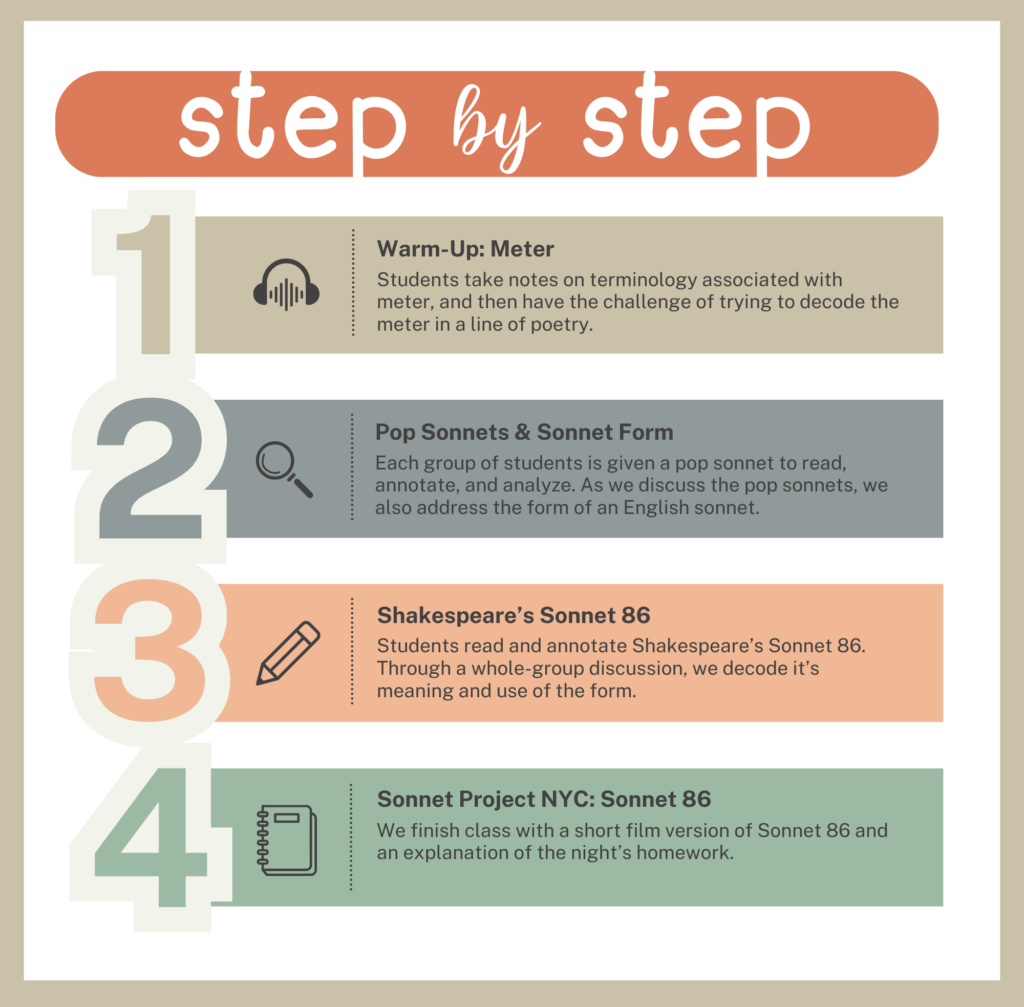
Here’s the full breakdown of the lesson if you want to read the fine print 😉:
- Warm-Up: Meter — I introduce meter, including the term “feet,” the names of feet, and the terms for the number of feet in a line of poetry. We work towards scanning the line “I am a pirate with a wooden leg” to discover it is, in fact, in iambic pentameter. Then, I pass out a “meter challenge” to the students. I have four different lines of poetry and they have to try to determine the meter. You can have them do this collaboratively, or jigsaw one line to each person and then have them meet up with people with the same line to see if they agree, etc. I’m not looking for mastery, nut rather a general understanding of the concept. Here are the lines I use:
- “just for a handful of silver he left us” (Robert Browning, “The Lost Leader,” with variation in the last foot) = dactylic tetrameter
- “Double, double toil and trouble; / Fire burn and caldron bubble.” (Shakespeare, Macbeth) = trochaic tetrameter
- “This is the forest primeval. The murmuring pines and the hemlocks.” (Longfellow, “Evangeline,” with variation in the last foot) = dactylic hexameter
- “From the center all round to the sea” (William Cowper, “The Solitude of Alexander Selkirk”) = anapestic trimeter
- Pop Sonnets & Sonnet Form — I give each student group a pop sonnet and ask them to read for (a) understanding and (b) to determine the structure of the English/Shakespearean sonnet. I assign group members roles to keep them accountable. The roles are “leader,” “reader,” “note-taker,” and “speaker.” The reader reads the poem aloud to the group, the note-taker keeps record of the group’s ideas, the speaker shares out with the class at discussion time, and the leader keeps the group on task. In the whole-class discussion, I like to add a bit of drama to the “big reveal” and I play bits of the music on which the pop sonnets are based. However, we also talk about the structure and the relationship between structure and meaning. Particularly, I suggest that the sonnet is a means of providing an organization to the complexity of the human experience. I also talk a bit about the history of the sonnet and pull in Paul Oppenheimer’s quote from The Birth of the Modern Mind: Self, Consciousness, and the Invention of the Sonnet: The sonnet is “the first lyric of self-consciousness, or of the self in conflict.”
- Shakespeare’s Sonnet 86 — After the pop sonnets, we read Shakespeare’s Sonnet 86. I have students work in groups of four and label themselves A, B, C, and D. Then, they do a think-aloud activity (see photo below). Finally, after the the think-aloud, we talk through the poem together under the document camera.
- Sonnet Project NYC: Sonnet 86 — We end class by watching the Sonnet Project NYC’s short film version of Sonnet 86. For homework, I ask students to find a different Sonnet Project NYC short film and write a discussion board post (using our LMS, Canvas) discussing the sonnet itself and then analyzing the extent to which the short film brings the sonnet to life.



One Response