

I’ve also just added a full unit overview here!
I begin second semester with a study of fixed form poetry, and I like to have fun on the first day back from winter break (read: an English teacher’s version of fun), so this collaborative sestina lesson works well. We begin by reading and analyzing a sestina together (I’ve chosen “Sestina” by Elizabeth Bishop). I purposefully do not explain the form up front, instead allowing students to figure it out as we move through the text. After we’ve discussed the poem and defined the form of the sestina, then we work collaboratively to write a sestina. It’s a silly exercise to some extent, but they leave class having analyzed a complex poem and garnered a strong understanding of the form. I’ll share my step-by-step below. Feel free to steal, modify, add, etc. The whole point of this blog is to share what has worked for me in case it’s useful to anyone who stumbles upon it. I’ve benefited a lot from generous teachers over the years.
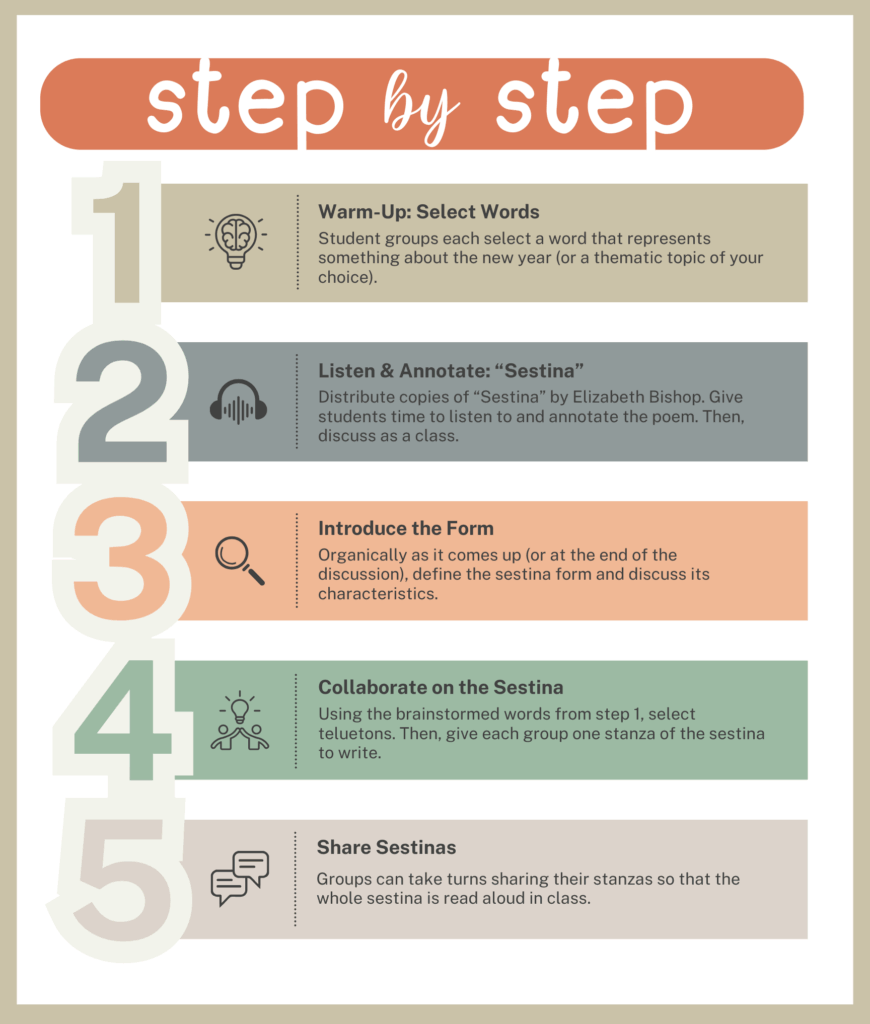
Here are the steps more specifically, if you’d like all the details:
- Warm-Up: Select Words — At the very start of class, I ask student groups (my students are always seating in group formation) to each select a word related to the new year. I choose this topic because I do this lesson on the first day back from Winter Break, shortly after New Year’s Day. You could select any thematic topic or even have students vote on one. Each group writes their word on a white board and then sets it aside.
- Read & Annotate: “Sestina” — Students listen to and annotate “Sestina” by Elizabeth Bishop in two rounds. This gives us the jumping off point for our whole-class discussion. After the two rounds, I put the poem under the document camera and open the floor for observations. I mark up my copy of the text as students share, and by the end we have a good understanding of the text’s meaning at a literal and figurative level. These are the prompts I give students:
- Round 1: What is happening in the poem at the literal level? Who are the characters and what are they doing?
- Round 2: As you listen, underline or highlight 3+ places in the poem where it’s clear that the surface does not reflect the full story. What is implied in this poem—what is lurking just under the surface? Write your answer on your paper.
- Introduce the Form — At this point, I introduce the essential question for our unit: What is the relationship between a poem’s form and its meaning? I ask students to define the sestina’s form and we discuss stanzas, envoi, enjambment, shift, and teleutons. I ask them to consider how the sestina form impacts the meaning of the poem “Sestina.”
- Collaborate on the Sestina — Finally, I reveal the purpose of the words that the groups brainstormed at the beginning of class. Each one (six in total) is given a number and becomes one of the teleutons. Note that I have 32-34 students, so I actually have eight groups of four. As a result, as a class we vote on two of the words to become the title while the other six are teleutons. Then, I assign each group a stanza to write with the teleutons in the correct placement at the ends of the line. I usually set a 10-15 minute timer for this task.
- Share — At the end of the period, each group reads their stanza aloud, so that we can enjoy the entire sestina as a class.
As a side note, I teach on an 85-minute block period, and this lesson fills the class from beginning to end.




4 Responses